Hip
Pediatric / Congenital
Evidence: suggestive
Abduction Test (Hart's Sign) Special Test
Orthopedic Physical Examination & Clinical Assessment Guide
What is it used for?
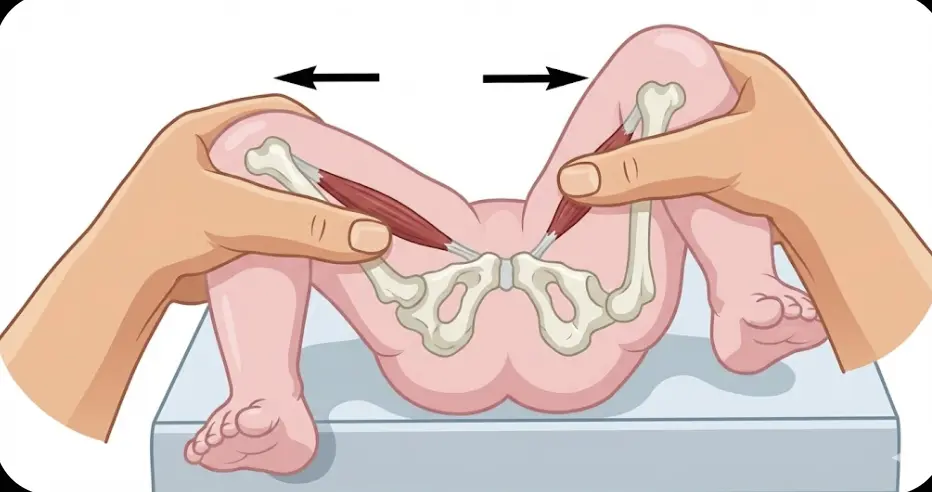
- Screening for Developmental Dysplasia of the Hip (DDH) in older infants where Ortolani is no longer effective.
How to Perform
- Position: Infant lies supine with hips flexed 90°.
- Action: Examiner gently abducts both hips simultaneously.
Interpretation of Results
- Positive Test: Limitation of abduction on the affected side (often <60°).
Clinical Context & Limitations
The Abduction Test (Hart's Sign) should be considered as one component of a comprehensive musculoskeletal assessment. No single special test has perfect diagnostic accuracy; thus, clinical decision-making should integrate test results with patient-reported symptoms, mechanism of injury, functional impairment, and relevant imaging.
Clinicians should be aware of potential false-positive results in patients with pain sensitisation, muscle guarding, or poor relaxation. For the Hip region, combining the Abduction Test (Hart's Sign) with complementary examination tests significantly improves overall diagnostic confidence.
References
- Magee, D. J. (2021). Orthopedic Physical Assessment.