Spine
Lumbo-Sacral Spine
Evidence: confirmed
Springing Test Special Test
Orthopedic Physical Examination & Clinical Assessment Guide
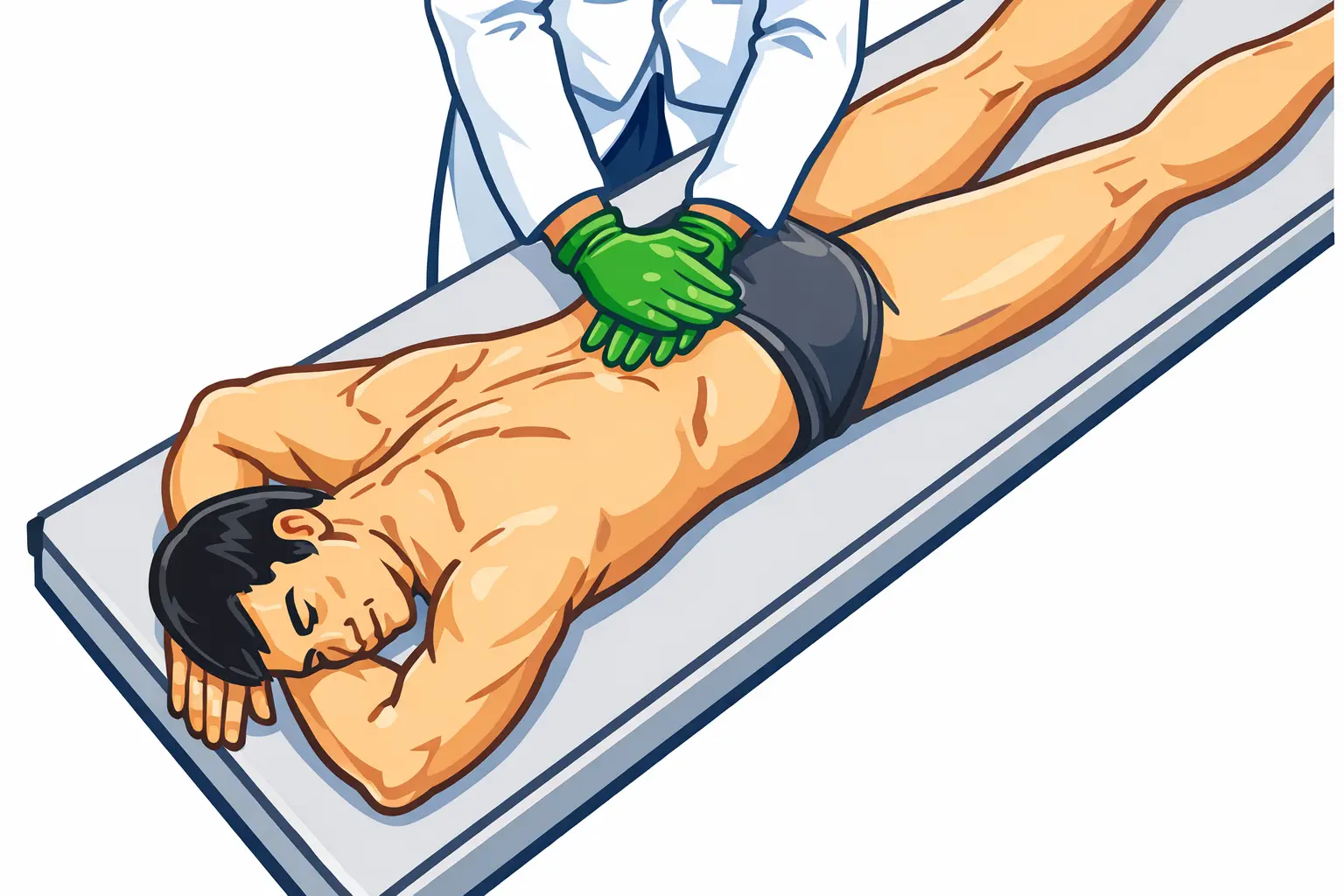
What is it used for?
- Assessing Segmental Mobility (Stiffness vs Instability) and Pain provocation.
How to Perform
- Position: Patient prone.
- Action: Use the heel of the hand (or ulnar border) to apply gentle springing pressure (Posterior-to-Anterior) on specific vertebrae.
Interpretation of Results
- Hyper-mobility: The vertebra moves too much (Instability).
- Hypo-mobility: The vertebra feels stiff/blocked.
- Pain: Indicates local facet joint or disc irritation.
Clinical Context & Limitations
The Springing Test should be considered as one component of a comprehensive musculoskeletal assessment. No single special test has perfect diagnostic accuracy; thus, clinical decision-making should integrate test results with patient-reported symptoms, mechanism of injury, functional impairment, and relevant imaging.
Clinicians should be aware of potential false-positive results in patients with pain sensitisation, muscle guarding, or poor relaxation. For the Spine region, combining the Springing Test with complementary examination tests significantly improves overall diagnostic confidence.
References
- Clinical Tests for the Musculoskeletal 3rd Ed. Book